
Blog · Permits & Violations
The Permit Nobody Closed
What a brick two-family in Queens taught me about open permits, a Certificate of Occupancy that did not match the building, and violations quietly compounding into a lien.
By Alexander Rubinstein, Founder & Principal Broker, Real Estate Plan
The work is almost never the problem. The paperwork is. I learned that as a seller, not as a broker — on a building I owned, in a deal that almost died three weeks before closing.
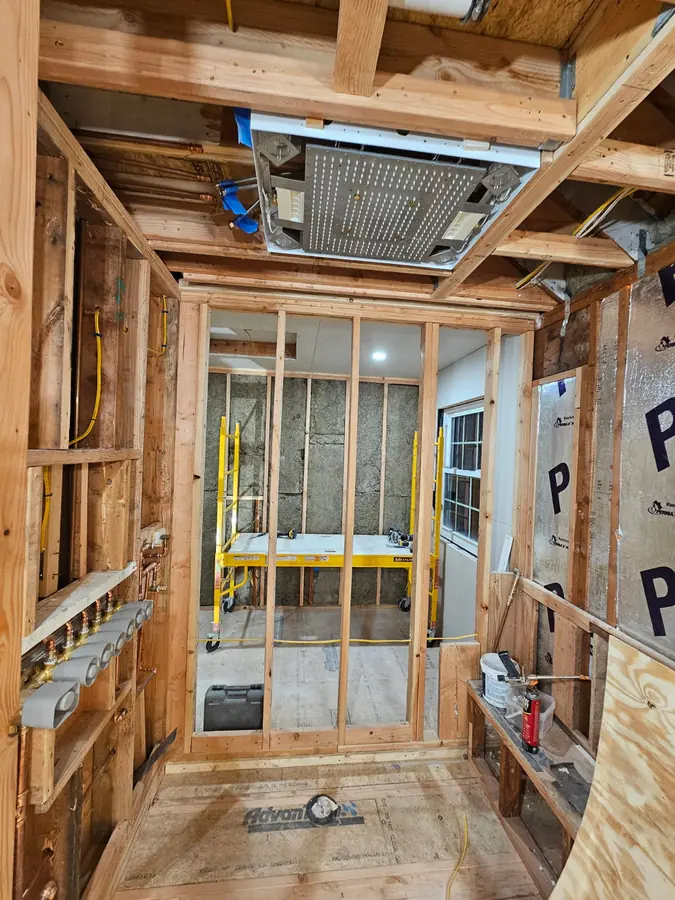
Look at the photo. Every wall is open. The copper manifold is exposed, the wiring is visible, the ductwork is hanging where anyone can see it, and the subfloor is still bare. This is the rough-in stage, and it is the single most important moment in the life of a permit — the point at which an inspector is supposed to walk through, look at all of it, and sign.
What happens next decides whether the house sells cleanly in ten years. If the inspection happens, the permit gets closed and the file is finished. If it does not — if the contractor moves on, or the owner forgets, or everyone simply assumes somebody else handled it — then insulation and drywall go up over perfectly good work, and the only surviving record of whether anyone ever looked is a line in a municipal database that says the job is still open.
Nobody notices for years. Then somebody sells.
I was the one who got blindsided
The first multi-family I ever bought was a brick two-family in Queens. I was young, I was proud, and I thought I had done my homework. The numbers worked, the tenants paid, the building had good bones. For years it did exactly what I wanted it to do. When the time came to sell, I assumed the hard part was behind me — I had owned it cleanly, paid the mortgage on time and kept the place in good repair.
We went into contract quickly. Strong buyer, good price, conventional financing, a reasonable closing date. I was already mentally spending the proceeds. Then the buyer’s lender ordered title, and the report came back with a page of exceptions I had never seen in my life.
There was an open building permit from a renovation the owner before me had filed — work that had been done but never inspected, never signed off, sitting open for years, quietly waiting for someone to care. The basement had been finished into comfortable living space that was already there when I bought the place. But the Certificate of Occupancy on file described a two-family dwelling with an unfinished cellar. On paper, that basement did not exist. And because someone, somewhere, years earlier, had complained, there were two municipal violations attached to the property with penalties that had compounded into real money.
I will never forget the call from my attorney. He was calm, which somehow made it worse.
“You have open violations, an open permit, and a C of O that doesn’t match the building. The lender won’t clear to close until this is resolved. The buyer is getting nervous. You need an expediter and an architect, and you need them this week.”
— from Real Estate Plan: A Guide to Successfully Listing and Selling Your Home
What followed was six weeks I would not wish on anyone. An expediter to pull the full job history. An architect to file drawings and close out the permit. Penalties that had grown far beyond the original fines because they had gone unanswered. A hearing. Legal fees on top of legal fees. And every single day, the very real fear that the buyer would invoke the financing contingency, walk away, and leave me starting over with a property now carrying a documented cloud.
The deal survived. Barely, and almost two months late. Here is the part that still stings:
“I did not get blindsided by something secret. I got blindsided by something I never bothered to look up.”
The open permit was public record. The violations were sitting in a database any member of the public can search. The C of O discrepancy would have jumped off the page the moment anyone compared the document to the actual building. None of it was hidden. I just never looked.
Three different problems, three different mechanisms
Sellers tend to lump these together. They are not the same thing, and they fail in different ways.
An open permit is a job that was authorized and never signed off. The work may be flawless and decades old. To the town it is unfinished business, and it outlives the contractor who filed it and the owner who hired him. A buyer’s lender may refuse to clear the loan until it is closed, which turns a records problem into a financing failure.
A Certificate of Occupancy is not about a job — it is about the building. It states the legal use: single-family or two-family, the number of stories, the approved layout. A finished basement, a converted garage or a third unit that does not appear on it is unpermitted space, however long it has been there and however well it is finished. The book’s line on this is the one I quote to sellers most often:
“When the document and the building disagree, the building always loses the argument at closing.”
A violation is the town formally on record saying something is wrong — building, zoning, fire or health. The danger is not only the violation. It is the penalties compounding in the background until they are large enough to attach to the property as a lien that has to be satisfied before clean title can transfer. A small violation resolved promptly is an annoyance. The same violation ignored for years is a four- or five-figure surprise paid out of your proceeds at the closing table, often with interest.
The seller always finds out last
That is the structural problem. Every professional in the transaction is looking at the property on the buyer’s behalf. The buyer’s attorney runs the municipal search. The buyer’s lender orders title. The buyer’s appraiser decides what square footage counts. Nobody in that group is working for you, and none of them go looking until you are already under contract with a closing date and a moving truck booked.
So the first time most sellers learn the true legal condition of their own house is when a title objection letter arrives — at the exact moment they have the least leverage and the least time. As the book puts it: surprises that surface after you are under contract do not just cost money. They cost leverage.
What to do before you list
None of this requires a lawyer to start. It requires a couple of hours and a willingness to find bad news early.
- Pull your full permit history. Most large building departments let you search by address online. Read every entry against what you know about the house — every renovation, addition, deck, pool, water heater, electrical upgrade and boiler swap should have a permit that reached final sign-off.
- Get a copy of your Certificate of Occupancy — then walk the house with it. Count the units. Read the described layout. Look at the basement, the attic, the garage and any addition with the document in your hand. This is the step almost every seller skips.
- Search violations at every agency with jurisdiction, not just the obvious one. In complex jurisdictions a single search is not enough, and missing one is how a clean-looking property hides an expensive problem.
- Decide your strategy while you still have all of them. Legalize, correct the record, disclose and price for it, or remove. Before listing, all four are open to you. Under contract, most of them are not.
If something turns up, it is not a catastrophe. It is a schedule. Many open permits close with a records request and a re-inspection. Most violations can be cured. What you cannot do is compress that work into the three weeks between a title objection letter and a closing date, which is exactly the position I put myself in on that Queens two-family.
“A two-hour records search at the start would have erased two months of fear.”
Why we do this before the sign goes in the ground
That building is the reason that on every listing we take, the compliance search happens before the photographer is called and before the price is set. We would rather find the bad news ourselves, on our own timeline, with all of the leverage still intact, than have a buyer’s lender find it at the worst possible moment.
And because the construction and restoration companies are ours, finding a problem and fixing it are not two separate phone calls to two separate vendors. The permit expeditor, the architect, the licensed contractor and the law office are all part of the same file.
Read the full detail on Permits & Violations — what an open permit actually is, the Certificate of Occupancy in depth, and the three choices you have when something was built without one. For the deal-mechanics version, see Clearing Violations Before You List. For the title, lien and ownership side of the same search, see Estate Planning.
Or just call us at 631-465-0440 before you list, and let us look first.